Showing posts with label setting. Show all posts

Friday, April 25, 2014

The Sunken Lands

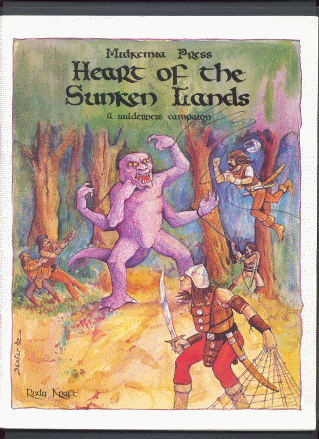
I've posted in the past about Midkemia Press, and the Midkemia setting published in the late 70s and early 80s. I've started reading Heart of the Sunken Lands, a wilderness campaign of exploration, discovery, and getting either rich or dead. It really is a wonderful setting, and you could find ways to insert into campaigns not set in Midkemia.

The book describes The Sunken Lands, a vast wilderness created from a mountain range when the gate to Kelewan was closed 800 years ago (events in Feist's Magician). The resulting backlash of magic destroyed the mountain range and twisted the inhabiting people, creatures, and plants. 

Now, expeditions are mounted into the interior of the area, looking for gems, exotic animals and plants, wood, insects, and other resources. 

Jonril: Gateway to the Sunken Lands is a companion book that details the city of Jonril, situated just outside the pass into the Sunken Lands. The two books really go together. A large part of the purpose of the city is to supply the many explorers going into the wasteland. As in the California Gold Rush, it is the outfitters that get rich, not necessarily the prospectors.

The Midkemia books use the Tome of Midkemia rules, which were never published. They are vaguely D&D-like, with levels, Hits To Kill (HTK), and percentile skills. Monsters have Armor Ratings (translatable to AC), HTK, size, attacks, damage, and movement, and they are very easy to translate to D&D or a clone. So, it will be extremely simple to run using any D&D variant. 

I've decided that I want to run this. I want to use Beyond the Wall and Other Adventures for the ruleset. It has skills, and the magic is something I like. Building connections between the PCs through character generation is also a wonderful thing. I was thinking about using Heroes and Other Worlds, but the translations would be somewhat harder.

I went to FedEx Office and made 17"x22" copies of the players maps of Jonril, Tulan of the Isles, and The Sunken Lands (as well as a scanned image of the map).

To get used to the nature of hexcrawling in the Sunken Lands, I'm going to start by doing some solo explorations. Then I'll have some NPCs that have been through a few expeditions and have tales to tell.

Friday, June 21, 2013

DNA Apocalypse -- Recreating the OD&D default setting

+Wayne Rossi wrote a series of blog posts about the default setting of OD&D as presented in the encounter tables and the Outdoor Survival map. He combined them into a PDF here

My mind started a background thread on this default setting, and I've come up with a history that combines the seemingly disparate elements. So I present to you:

The DNA Apocalypse


It all started with the magnificent Wooly Mammoth. Scientists brought back the wooly mammoth, using DNA from frozen carcasses found in the permafrost of Siberia. Based on their success, the rest of the extinct Ice Age animals were next: giant sloths, wooly rhinos, scimitar cats, cave bears, etc. After that, the Holy Grail of dinosaurs were produced, using the exact techniques proposed in Jurassic Park by Michael Crichton. Huge preserves and islands kept these ancient beasts contained. Theme parks were built: Jurassic Park and Neanderthal Land. A Christian billionaire built one that put humans and dinosaurs together, like Raquel Welch in the movie, 1 Million Years B.C. The reconstituted creatures from the distant past became the latest technological marvel and made the financiers very rich. 

They tried their hands at creatures that never existed. They made dragons from pterodactyls and goblins from a mixture of human and animal DNA, and started a medieval fantasy park. They made the chimera, the manticore, and a human-bull hybrid, the Minotaur, for the Greek Myth park,  Green Martians and white apes filled Barsoom-on-Earth. Only males were produced. Their fertility was genetically turned off. The parks were secured by the latest in technology. They learned from Michael Crichton, putting more safeguards into both biological and technological security.

Within this backdrop is a world where the gulf between the richest and the poorest was expanding. The rich played while the poor slaved. A group of anarchist hackers decided to even the playing field by hacking the infrastructure of the world. The chaos they caused began a war of trojan horses and computer viruses between governments and hackers. It was not known which side made the mistake, but one poorly written virus went out of control and caused a six-day worldwide blackout.

By the time the lights came back on, all of the monsters of the past and imagination had escaped their techno-zoos. Nature abhors a vacuum and unproductive life. The genetic fertility barriers were overcome by mutations, and some of the males reverted to being females. The monsters could breed now. 

All hell broke loose. Economies crashed as monsters roamed the Earth, destroying farmland and cities alike. The military tried to stop them, but it was too late. Civilization spiraled down.

10,000 years later, the Earth is inhabited by a variety of hybrid races, plants with animal characteristics, and just plain monsters. The world has countless ruins of shining glass cities. Feudalism and empires have returned. Through mutation and hard study, some groups have developed the powers of the mind. There are heroes and wizards among us.